My Personal devotions translated into a visual guide—strategic, grounded, and ready for real-life application.
No Reserve. No Retreat. No Regrets.
The William Borden Story — The Man Who Walked Away From $33 Million

Brothers & Sisters. In 1904, a young man inherited a fortune worth $33 million in today's dollars. He was a Yale graduate. He could have led a financial empire. Instead, he gave it all away. He sailed for the mission field. He died at 25 — and the last words found in his Bible were: "No Reserve. No Retreat. No Regrets."
This is the story of William Whiting Borden — and it's a question aimed directly at every man and woman who has ever chosen safety over surrender.
Who Was William Borden?
Heir to millions. Yale graduate. Dead at 25. And he wouldn't change a thing.

Born in 1887 to the wealthy Borden family — heirs to the Borden dairy and real estate fortune — William Whiting Borden had everything the world promises: money, status, education, and connections. In 1904, at just 16 years old, he inherited over $1 million (roughly $33 million today). He graduated from Yale in 1909 and attended Princeton Seminary.
By every worldly measure, Borden was set. He could have run the family empire, sat on boards, lived in mansions, and retired early. Instead, he felt God calling him to reach the Kansu Muslims in Northwest China — one of the most unreached, remote people groups on earth. He chose to go. And that choice cost him everything.
$33 Million — Gone
He didn't "fail" into missions. He walked away from the top.

This is what makes Borden's story different from most missionary biographies. He wasn't running away from a dead-end life. He wasn't desperate. He didn't need God to "fix" things — by every metric, his life was already fixed. He was running from success, toward a cross.
Before leaving for the mission field, Borden gave away his entire fortune — to missions organizations, to Bible distribution, to the poor. He didn't set up a trust fund for himself. He didn't keep a safety net. He gave it all. Every. Last. Dollar.
For those of us in finance, business, or any field where net worth is the scoreboard — his decision is a direct confrontation: What if the money isn't the point?
🙏 Pray
"Father, am I holding onto money because I trust it more than I trust You?"
🪞 Reflect
"If I gave away everything I have, would I still believe God is good? What does that say about my faith?"
⚡ Act
"Calculate what you spent last month on comfort. Ask God if any of it should be redirected."
"No Reserve."
Written in his Bible when he gave away his fortune.

After giving away his inheritance, Borden scribbled two words in the back of his Bible: "No Reserve." It wasn't a slogan. It was a covenant. He was declaring to God — and to himself — that nothing was held back. No portion reserved for comfort. No secret stash "just in case." No fallback plan.
For those of us who keep one foot in the kingdom and one foot in the market, "No Reserve" is terrifying. It means the 401(k), the emergency fund, the portfolio — none of it is your actual security. God is. And if He asks for it, you hand it over without flinching.
This doesn't mean everyone is called to give away everything. But it means no one is allowed to hold anything in a fist. Open hands. Total availability. That's "No Reserve."
📖 Key Scriptures
Yale Revival: 1,000 Students on Their Knees
He didn't just leave — he set the campus on fire first.
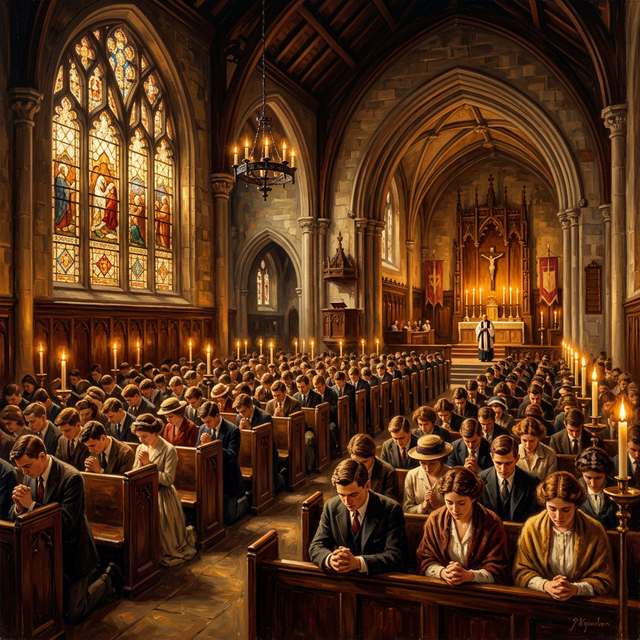
While at Yale, Borden didn't retreat into quiet piety. He started a prayer meeting. One student. Then ten. Then fifty. By the time he graduated in 1909, over 1,000 of Yale's 1,300 students were regularly gathering for prayer. Nearly 77% of the student body.
He also founded the Yale Hope Mission — a ministry to homeless and addicted men in New Haven. He didn't just talk about serving the poor; he went to them, week after week, while studying at one of the most elite universities in the world.
For those of us who think faith is a "private thing" — Borden's life says otherwise. Real faith disrupts your environment. It doesn't stay quiet. It overflows.
🙏 Pray
"Lord, am I hiding my faith to protect my career? Give me the boldness to live it out where I am."
🪞 Reflect
"What would it look like if I started a prayer movement in my workplace, industry, or social circle?"
⚡ Act
"Invite one colleague, friend, or neighbor to pray with you this week. Start with one."
The Call to China
Burdened for the Kansu Muslims — some of the most unreached people on earth.

After Princeton Seminary, Borden felt a specific, unshakeable burden for the Kansu Muslims in Northwest China. Not a glamorous field. Not a comfortable assignment. Not a place where a Yale grad's résumé would impress anyone. But God had spoken, and Borden would not negotiate.
He planned to travel to Egypt first to study Arabic (the Kansu Muslims spoke a dialect influenced by Arabic), then continue overland to China. He packed light. He left America with no return ticket. He watched the New York skyline disappear behind him — the city where his family's fortune was built — and sailed toward a life of obscurity, hardship, and service.
📖 Key Scripture
"No Retreat."
Written in his Bible when his father offered him a VP position as a fallback.

Before Borden left for the field, his father made him an offer: a guaranteed VP position at the Borden Company. If missions "didn't work out," there would always be a corner office waiting. It was the ultimate safety net — reasonable, practical, loving even.
Borden's response? He opened his Bible and wrote: "No Retreat."
He would not keep an exit strategy. He would not leave a door cracked "just in case." He burned the ships. The Borden Company would go on without him. The money would go on without him. The only way was forward.
For every person reading this who has a "Plan B" that keeps them from fully committing to God's call — husband, wife, parent, professional — this is the confrontation: What retreat are you keeping open?
📖 Key Scriptures
Death in Egypt — Age 25
He never reached China. He never saw the "results."

In Cairo, while studying Arabic, Borden contracted cerebral meningitis. On April 9, 1913, William Whiting Borden died. He was 25 years old. He never reached China. He never preached to the Kansu Muslims. He never saw a single convert from the field he'd sacrificed everything for.
By the world's scoreboard, it looks like a waste. A brilliant young man, $33 million, a Yale degree, a Princeton education — all "thrown away" for a mission that never happened.
But God doesn't score by our metrics. The seed that falls into the ground and dies bears much fruit (John 12:24). Borden's death became more powerful than his life ever could have been as a business executive.
"No Regrets."
The last words found in his Bible. Peace — not bitterness — in the face of death.
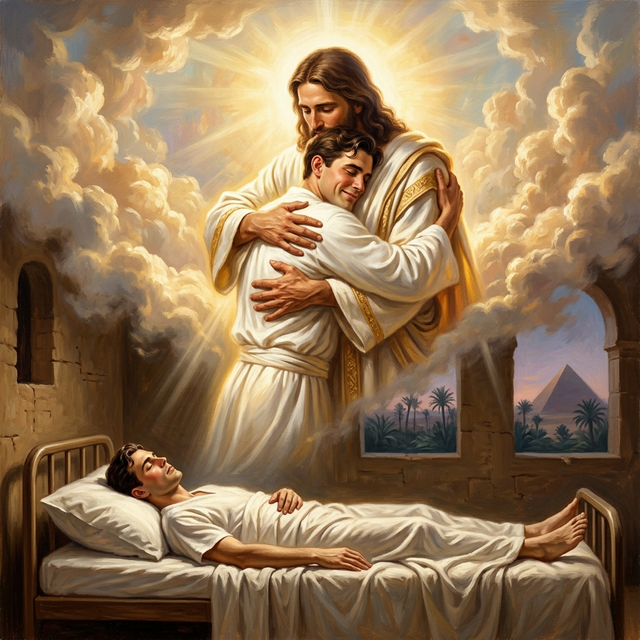
After Borden's death, friends opened his Bible and found three phrases written at different stages of his journey: "No Reserve." "No Retreat." "No Regrets."
There was no bitterness. No "what ifs." No journal entry wondering if he'd wasted his life. Just peace. The kind of peace that only comes when you know — to the bottom of your soul — that you did exactly what God asked, even when the results weren't yours to see.
This is the question Borden asks everyone who reads his story: When you get to the end, what will you have written? Will it be "I played it safe"? Or will it be "No Regrets"?
What He Left Behind
His death accomplished more than most lives.

Borden's journals, Bible, and letters were published as a book: Borden of Yale. It became a sensation. Thousands of young people read his story and gave their lives to missions. His death didn't end his impact — it multiplied it exponentially.
His giving funded missionaries for decades. His example inspired Jim Elliot, Nate Saint, and an entire generation of 20th-century missionaries. His three phrases — "No Reserve. No Retreat. No Regrets." — became one of the most quoted lines in mission history.
The man who "wasted" his life produced more fruit than a thousand corner offices ever could. The legacy that lasts isn't the one you build on a balance sheet. It's the one you build on a cross.